Four short doors. No prior reading required — the works themselves carry these ideas better than words can, but words can point.
◐
Ground & Pattern
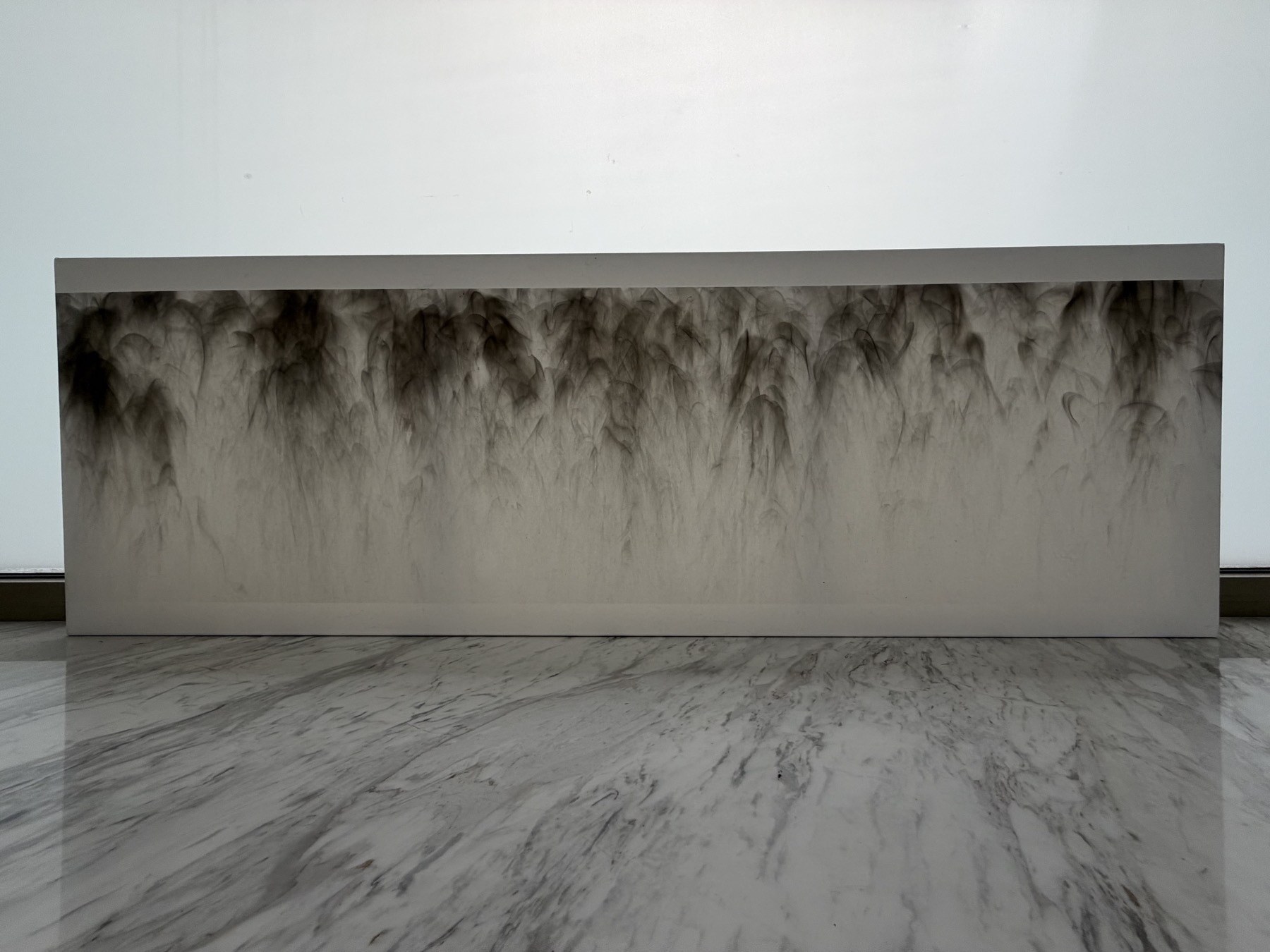
Fumage — Descending Smoke · smoke trace on paper
The smoke paintings begin with almost nothing: a stencil, a direction, a breath. Structure is introduced — and something larger responds. You can see the moment where the undifferentiated medium begins to gather around a form, and you can see that the form is not entirely mine. The smoke has preferences of its own, regions it falls into more readily than others. The final image is not planned. It is arrived at.
I have spent seventeen years as a psychotherapist, and I recognise this process from the consulting room. A person arrives with a story — what happened, who did what, when. But beneath the story there is a charge, a feeling that exceeds the words. The work, in the studio and in the room, is the same: to hold a steady enough container that the formless can come into form — without betraying the formless it came from.
Every pattern rests on a ground that has none. That ground is not nothing. It has structure. And the quality of attention we bring — to a canvas, to a person, to a difficult text — shapes what can emerge from it.
◇
The Fold
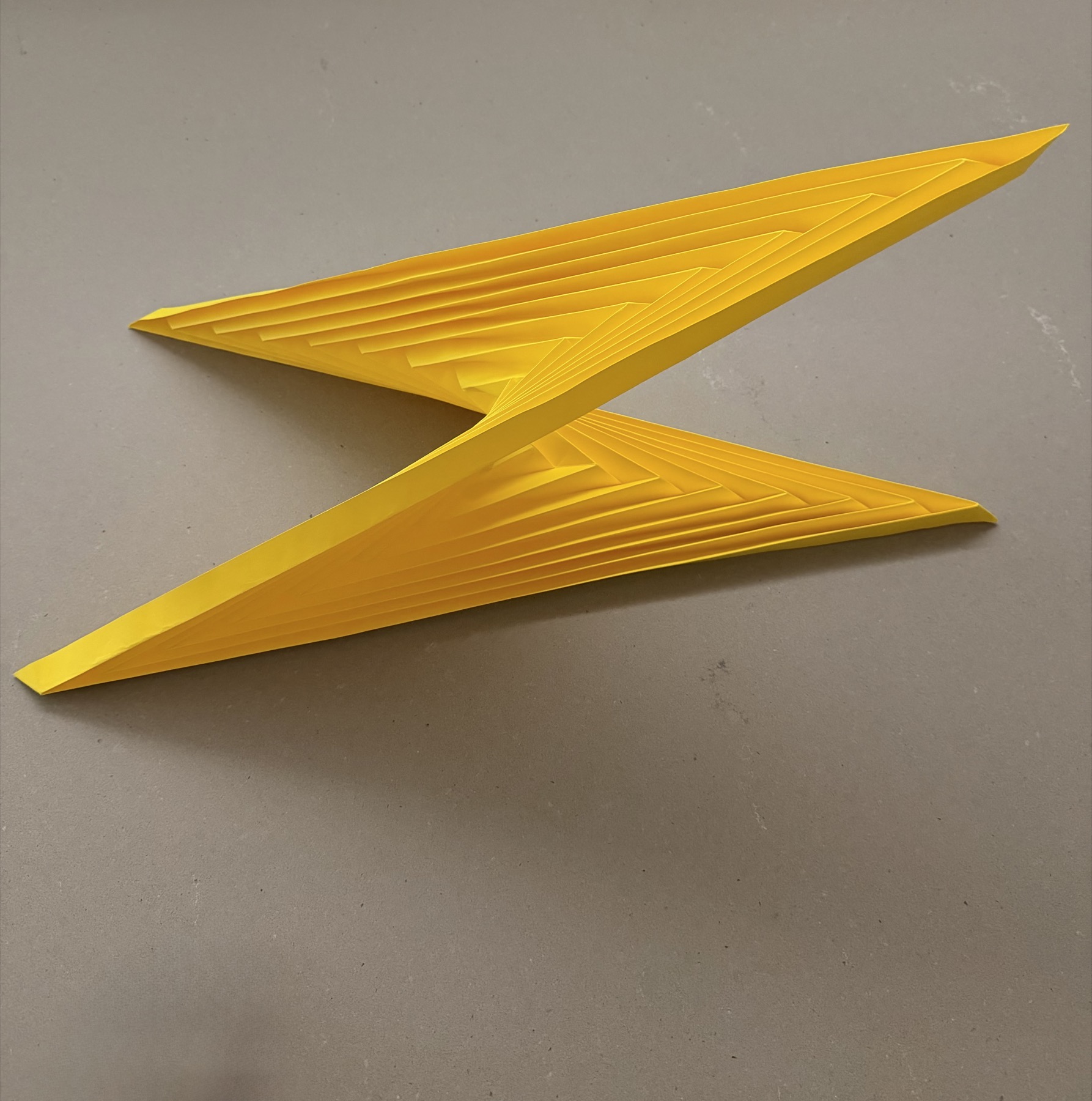
Hyperbolic Paraboloid · folded paper
Take a square sheet of paper. Score it with evenly spaced straight lines, and fold. Something happens that you did not plan: the surface curves. Not because you introduced a curve — you didn't. Every line you scored was straight. But the accumulation of straight folds produces a smooth, continuous curve. The straight line, repeated with discipline, arrives at the curve.
Assemble eight of these folded forms and they make an eight-pointed star — a figure that appears in Babylonian astronomy, in Islamic geometric art, in the Hindu yantra, in the rose windows of Gothic cathedrals, and in the mandalas Jung drew during his confrontation with the unconscious. Traditions with no contact with one another, arriving at the same figure. No single fold contains the star. It was not designed. It was accessed.
That is what these folded works are: not representations of wholeness, but enactments of it. Forms you could hold in your hands — the particular producing the whole.
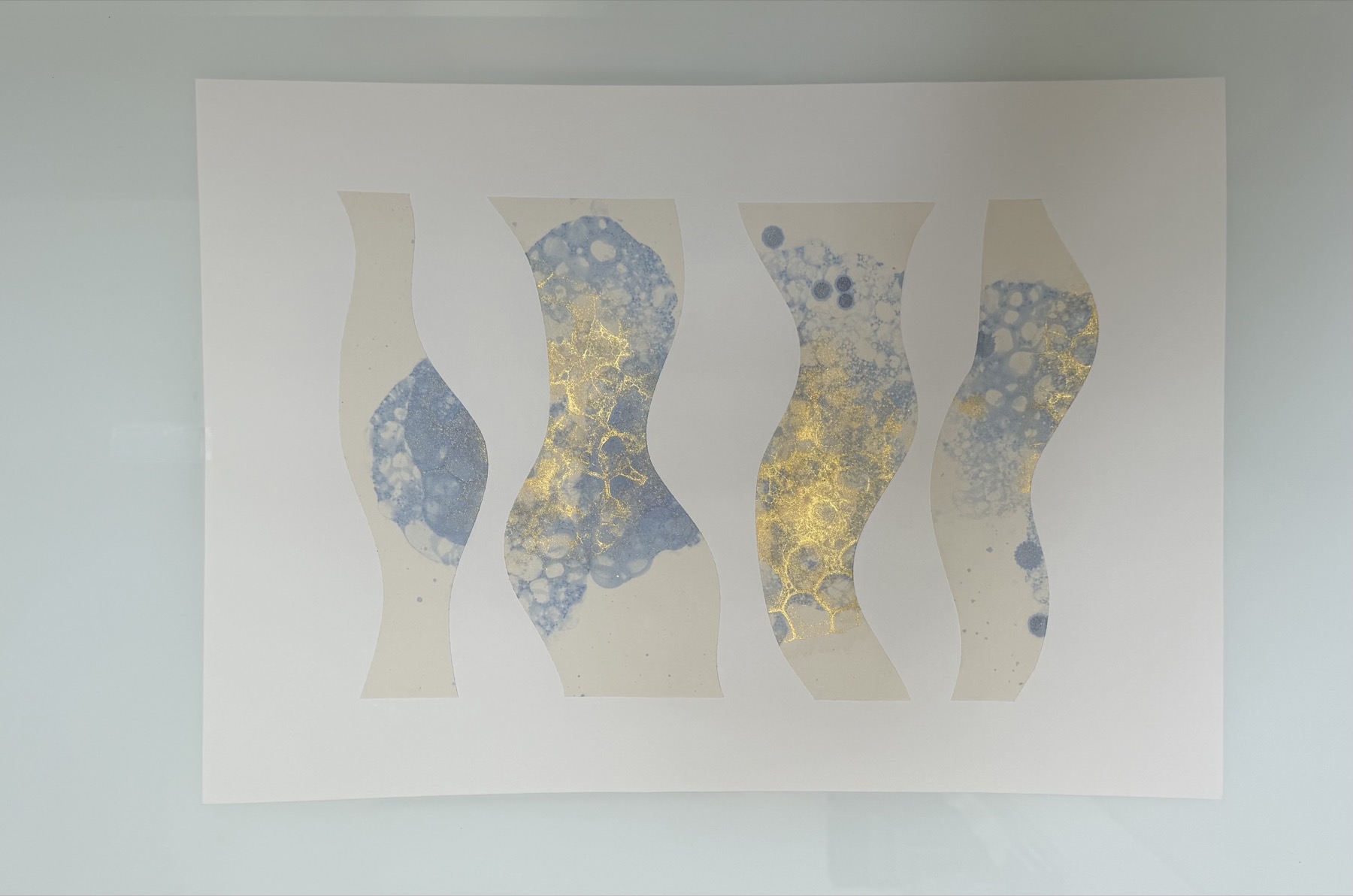
Bubble Trace — Four Panel · fumage and bubble trace
A Chilean psychoanalyst named Ignacio Matte Blanco asked a question Freud opened but never answered: what kind of logic does the unconscious run on? His answer: two logics, working at once. One is the ordinary logic of waking life — I am here, you are there, cause precedes effect. He called it asymmetric. The other treats things that feel alike as if they were the same. Part and whole collapse. Time becomes simultaneous. He called it symmetric.
You have been inside symmetric logic. When you fall in love, and the beloved stops being a particular person and becomes everything the word has ever meant — that is symmetric logic near the surface. When someone dies, and one loss opens onto every loss you have ever had, so that the death of one person feels like the death of the world — that is the symmetric deep, where all losses are one loss, and that one loss is infinite. These are not failures of thought. They are a different logic, running beneath the one we navigate with.
This site holds the works in both. Named, dated and ordered, they are the asymmetric view. But every page keeps returning to the ground beneath them — the smoke you found before any words appeared — where the works are not yet separate things at all.
ℵ
The Infinite in the Finite
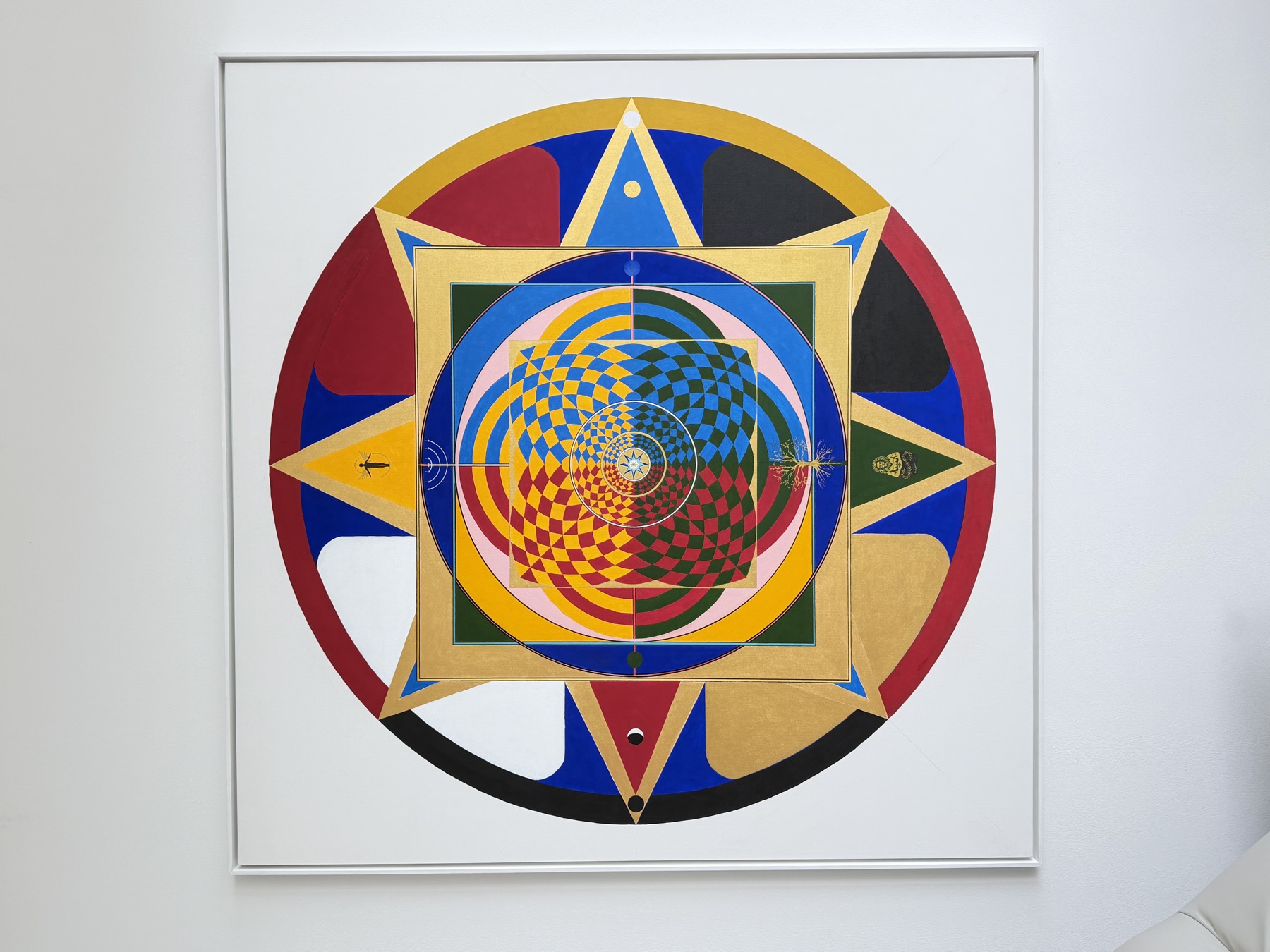
Systema Mundi Totius · acrylic and metallic pigment on canvas
The mathematician Georg Cantor proved something that still feels impossible: not all infinities are the same size. The infinity of the counting numbers is genuine — but it is the smallest infinity. The points on a line are a strictly larger one, and there are larger still. Infinities inside infinities, different in kind, not just in quantity.
Matte Blanco saw what this could mean for the mind: the deeper the stratum of the psyche, the vaster the infinity, the more distinctions have dissolved. At the surface, everything is particular — this person, this day, this loss. In the depths, part and whole are equivalent, and the unconscious cannot be exhausted. Seventeen years of clinical practice has taught me that much.
The mandala is what this looks like when it becomes an image. A centre. A boundary. And inside that bounded circle, a space that keeps opening inward — recursion within symmetry, worlds within the world. You can stand in front of one and fall a long way. The boundary is what makes the falling safe: the finite form that lets the infinite be looked at.
The works carry it better
Theory is scaffolding. The paintings, smoke and folded forms are the argument itself, conducted in a different register.